Contents | About | Contact
article 37, issue 37
Theo Schmidt
March 31, 2026
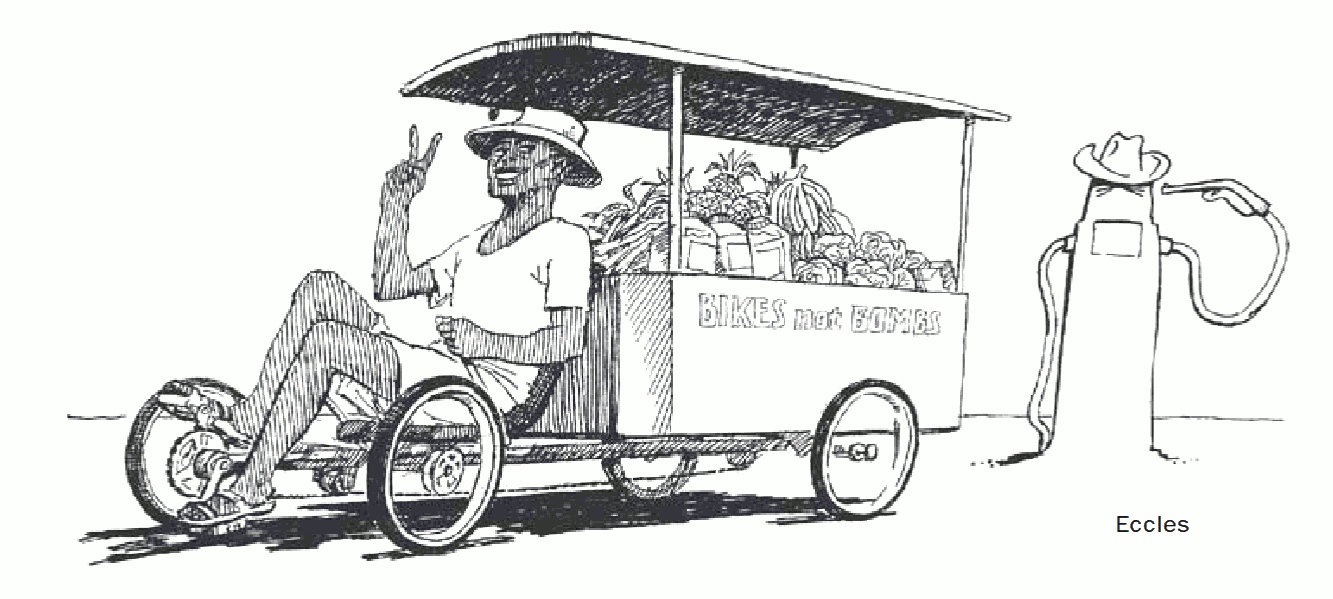
Editorial: In 2003 in Human Power issue 54 (download 3.6 MB) the above drawing by David Eccles was published. Richard Ballantine and I wrote editorials concerning the role of oil in the Irak war:
"[While] writing this, bombs and missiles are raining down upon Mesopotamia,this ancient land between the Tigris and Euphrates rivers, the cradle of human civilisation. The present population, trapped between the plans of a barbaric dictatorship and a group of ruthless businessmen, pays a heavy price for living on top of large deposits of oil. [...]
"The relatively modern accomplishment called democracy seems to have failed. Something is fundamentally wrong when a few men are able to launch wars against the wishes of the overwhelming majority of the world’s population, governments and churches. This war has divided friends, united foes, and accomplished the opposite of what its proponents claim. The businessmen have weakened the only legal world government, the United Nations, and are attempting to erect a kind of military-economic empire, to be defended by new technology. [...]
"What has this to do with “Human Power”? The main reason is the strong connection with oil. Oil is cheap in terms of money, but commands a heavy price in terms of human life. ... The Charter of the United Nations and associated works of International Law have been transgressed. Lies and deceptions abound. The land of the free is becoming the land of the fearful. Never before have the dystopias predicted by Orwell and Huxley gotten so close to reality. [...]
"Thanks to modern communications and independent media, disinformation and propaganda can be unveiled more quickly and anybody capable of logical thought can separate truths and untruths.The new information society is fighting back. The key to future peace is literacy. For example, people who read the classic Animal Farm by George Orwell may find out why our rulers employ soldiers and fire teachers, and how they subtly control us with methods more effective than censorship. As global awareness increases we may be heading for a new Renaissance and be able to escape the presently rather dark ages together. At some point we will become true humans. [...]
"The war in Iraq is about black gold. ... The oil will go to developed countries and be used to fuel motor vehicles. As every reader ... knows, the majority of journeys are short and local, and can be accomplished most efficiently by cycling. Standard upright bikes are great, but HPVs are better; faster, safer, and more comfortable. They are also practical for transporting freight. [...]
"Finally, and not least, HPVs suit modern demographic trends. The population of the world is increasing, and at the same time, more and more people are living in cities. In high density urban environments, where space is limited, bikes and HPVs are not just hugely more energy efficient than motor vehicles, they are also faster. Bombs and cars go together and in the end, HPVs will beat both."
Viewed today we erred in our conclusions, even if freight HPVs as depicted have arrived in many places. Information society has backfired, Orwell and Huxley surpassed, with more artificially produced lies than any human can cope with, and many bigtech and government leaders are leaning toward or even supporting neo-fascism. The new war on Iran is more complex with all sorts of reasons given, both real and made-up, but it is still about oil and the cartoon by David Eccles is just as valid today with an orange face and a red cap instead of a stetson. We are still so dependent on oil that rising prices are pushing inflation and also the price of transport and food, starving many. Mobility strategies for coping are driving less, using lighter and slower vehicles, pooling and switching to cycling and HPVs when possible.
For given longer distances, walking and even cycling may cost more than motoring because of the food required. This article examines the cost of fuel or food for transportation, comparing conventional motoring with human-powered mobility, for simplicity not covering motor cycles, electric vehicles and public transport, although some of these are in many cases the best choices. A second comparison is for off-road travel on the moon: is it better to pedal or use the sun?
Gasoline prices vary strongly depending on location and are at present rising everywhere. This data is widely available day by day and at the time of writing prices of gasoline per liter range from around one-third US-dollar in Egypt, Algeria and Kuwait, $0.5-0.6 in many Gulf countries and Iran itself, $0.9 in USA, over $1 in many Asian and South American countries including India, China, Canada and Australia, $1.6-2 in many European countries, Sweden and UK, and well over $2 in Scandinavia, Netherlands and Switzerland. If the country's purchasing power is considered, it evens up for many except the USA and especially the Gulf states, where the prices are effectively very low. For a middle value, let's take the numbers for Canada and assume one US-dollar per liter gasoline.
The automobile fuel consumption per distance varies enormously with vehicle characteristics and speed. However we can at present assume 6 liters per 100 kilometers (~39 MPG) as a statistical average at moderate steady-state speeds. Therefore the cost of fuel to travel one kilometer comes to 6 US-cents (¢) per vehicle.
Conventionally bicycles are described and accepted as the most efficient vehicles, or even more faired HPVs. What is often not considered is the food required, as it isn't noticed in utility cycling, masked by the greater amount required for living and normal daily activity. In addition, many people are overnourished and would like to lose weight. However, physically every joule (watt second) of human energy exerted needs about 4 J (1 J = ~0.24 kcal) eaten as food or supplied by body stores, e.g. glycogen or fat. In the long run, with constant body weight, this is a minimum value, that is you can "burn" food without activity, but physical activity must be paid for, in terms of energy and also often of money.
The cost of food varies enormously from free, such as when gathered in the wild, to hundreds of dollars per day in fine restaurants. However with statistics, the daily cost of a healthy diet for the year 2024, here adjusted for differences in living costs between countries, is given at $2.54 (UK) to $7.63 (Japan) and even $8.39 (South Sudan). Quatar, USA, Belgium and Austria are all under $3 and the Gulf states, Denmark, Switzerland, Netherland and Australia under $3.20. Europe & Central Asia average $4, Latin America & Caribbean $5.16. The world average is $4.46, so let's use this. The energy figure used as average for a healthy diet is 2330 kcal per day, so 1 kcal costs about 0.2 ¢. This is about15 times more expensive than for gasoline. The efficiency of converting chemical to mechanical energy is about the same for food and muscles as for gasoline and motors. However, bicycles and HPVs are much lighter and have lower-resistance tires than cars. The next section attempts to quantify "mileage" for cycling.
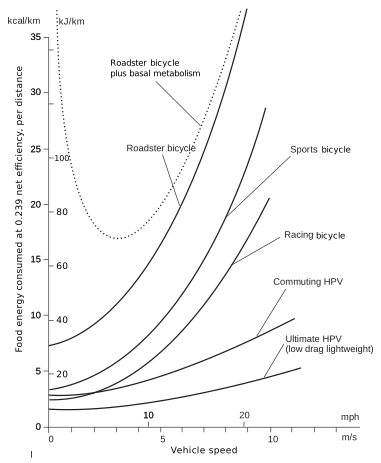
Consulting the figure below from chapter 4 in HPeJ article 30, we see that cycling with a very basic "roadster" bicycle at 5 m/s (18 km/h) works out at about 16 kcal/km, costing 3 US-cents/km, half the cost of driving a car. But this is slower. Cycling at 10 m/s with a sports bicycle would cost 6 US-cents/km, the same as driving, but this requires considerable fitness - or a fast pedelec electric bicycle. With faired HPVs more car-typical speeds can be achieved at still lower cost. However, so far we have considered only the driver. With a passenger the car's fuel cost per person halves, and with two more passengers, halves again. This is because cars are immensly heavy and the extra load is hardly felt.
Motoring is then cheaper than cycling - considering fuel or food only - when travelling at the same elevated speed. Typical car trips in slow urban traffic with only the driver cost more. Long-distance touring is also in favour of bicycles and HPVs if accepting the slower speeds and/or degree of fitness required.Food energy consumption in bicycling as a function of speed, assuming a net metabolic efficiency of 23.9%. Curves do not include basal metabolism (energy for living), except the dashed one for a roadster bicycle.
We have so far not looked at total costs. These can change the picture greatly. New cars and new (good) bicycles and HPVs cost a great deal, so that depending on total vehicle distance and lifetime, these costs can be higher than fuel and food costs. In many countries taxes, insurance, maintenance, parts, parking and obtaining a driving licence are a major cost factor, favouring human powered mobility. Considering external costs such as unpaid health and environmental costs amplifies this. A March 2023 detailed analysis on mobility external costs with data from Munich mostly during 2019-2022 presents as external costs per kilometer per person, if assuming 1.1 US-$ per Euro, for a gasoline car: 17.5 US-cents, almost 3 times the fuel cost given above. Cycling is rated at 7.4 ¢, about double or treble the food costs. Most of the cycling external costs are due to accidents. However, the health benefits from cycling greatly outweigh the costs, given at over 56 ¢/km per person per km. More extreme is walking. Here only 0.8 ¢/km are tabulated for external costs, clearly not considering food production, and 213 ¢/km health benefits, for Munich. This last example warns us that we must know all assumptions for a given conclusion. Walking is healthy when voluntary and mostly pleasant and safe (at least in daytime and for men) in places like Munich. Involuntary walking may be costly in terms of food energy and potentially unpleasant or even dangerous for some. Poor people forced to walk long distances may not be able to afford the food required and go hungry instead.
This article has shown that when considering only fuel or food, the costs of cycling and driving are closer together than is usually assumed. National differences can be worked out from the data and may point one way or the other. As soon as total and especially external costs are considered, human powered mobility is always better within practical suitability constraints.
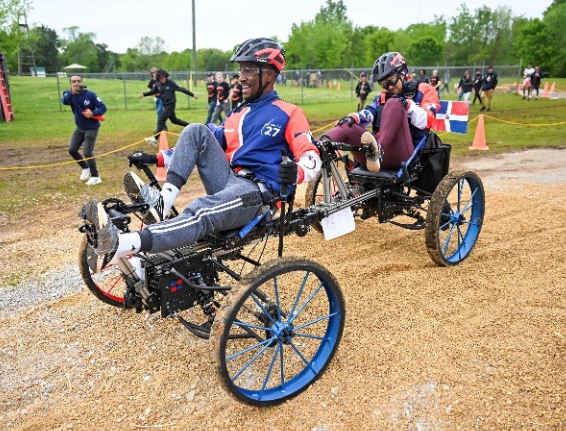
With the present revival of moon exploration and planned future moon bases, the food-or-fuel question poses itself also on the moon. The Lunar rover used in the NASA Appollo missions was powered by electric batteries and motors. Since 1994 NASA holds its Human Exploration Rover Challenge for students to build human-powered or remote-controlled rovers capable of traversing lunar terrain (see NASA picture). Although this is about education and preliminary research far from the over 1.5 billion dollar industrial bids to build the next motorized lunar terrain vehicles for the Artemis moon missions, NASA is clearly looking at all options.
Whatever the power source, the future cost of transporting material from earth to the moon is estimated at $100'000 to $1'000'000 per kg, whether this is food, solar panels or batteries. For calculating the effective cost of solar energy and batteries, the period of use must be defined.
The idea of a moon bicycle is a subject that keeps coming up and seems attractive because there is no aerodynamic drag. Gravity on the moon is also only one sixth of that on earth with a corresponding reduction in rolling resistance. Calculations show theoretical high speeds with most power used for acceleration. What is generally ignored is the resistance of natural terrain and bumps with the potential of jumps and crash landings - remember that mass is not reduced, so that upsets and collisions could easily become very serious.
And now there is the cost of food. If we assume food with 5 kcal/g, each extra kcal food energy on the moon costs $200 to $2000 if it is transported from the earth. For longer term moon settlement, food will be grown there using direct or indirect solar energy, presumably a bit cheaper in the long run. The cycling "milege" realised per kcal on the moon is potentially much higher than on earth on smooth surfaces or tracks, but in practice these may not be available and the moon cyclists must either wear space suits or be enclosed in pressurized pods and use breathing and other life support equipment. So for a ball-park figure let us use 10 kcal/km. Instead of the 2 ¢/km on earth from earlier, we now spend $1000/km to $10'000/km!
The 210 kg Apollo lunar rovers used non-rechargeble 8.7 kWh silver-oxide batteries in order to travel up to 36 km, half the maximum design range, averaging about 9 km/h. Future lunar vehicles are bound to use batteries recharged by solar panels. Configurations include no onboard solar panels with the range strictly limited by the battery capacity, small solar panels with long charging times, and larger solar panels with smaller batteries for more or less unlimited range.
The best commercially available lithium-based rechargeable batteries currently have energy densities of up to 300 Wh/kg = 1080 kJ/kg or 0.258 kcal/g in order to compare with the food values in kcal. So this is roughly 20 times less than food. However, food is consumed once, although the bodies waste products can in future be used to grow new food, whereas batteries today can be recharged hundreds of times. The maximum efficiency of human power is about 25%, that of electric motors over 75% including recharging and controlling losses. Solar panels producing 40 W/kg are commercially available, so the amount allowing 10 h full charges weigh less than the batteries. All in all, if the equipment can be used at least about ten times, the transport cost of batteries and solar panels becomes less than food providing the same motive power. However, an electric vehicle weighs more than a purely human powered one, so that more then ten charging cycles or trips are needed to achieve equality.
With the constant strong sunshine during the two-earth-week moon days, there is for these a good case for purely solar powered vehicles with perhaps only a minimal battery for acceleration and hills. A panel of one square meter could provide 300 W, over 4 times a persons steady-state power, maybe even more considering cooling and breathing equipment.
In practice a viable vehicle could carry as large a solar surface as practical, as large a battery as needed, and pedal generators for range extending and backup, fun and excercise. This brings us to the main reason to think about expensive human power in space at all, the minimum amount of excercise needed to stay healthy. On earth this can be as little as ten minutes per day of moderately vigorous excercise. In space it is certainly cheaper if this can be done while performing useful tasks.